Progress
Motor Tests and Launches
Fall 2026
Camila
Camila is AeroBing's return to composite casings, with a fiberglass motor. Designed to be a sustainer stage of a spaceshot, it will be test fired on Oct-3-2026
Motor Tests and Launches
Fall 2025
Sabrina was the motor created to be the motor implemented in Mary, with a total impulse of 6800lbf*s, it was the largest student created rocket motor ever tested in New York State.
Sabrina


Winter 2025
Mary
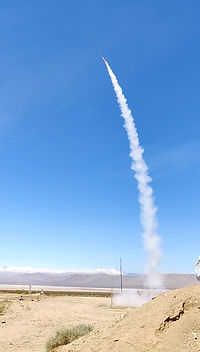
The vehicle launched on Saturday, December 20th, at 0830 PST at the Friends of Amateur Rocketry site. The motor performed exactly as designed, burning for approximately three seconds and producing an average thrust of ~2,000 lbf. Visually, Mary flew straight and clean through max-Q, and we observed a nominal motor burnout ; clear validation that both our structural analysis and motor design performed as intended.

Motor Tests
Spring 2024
Sally
Sally was the motor created to test both a new propellant mixture and to serve as a backup for Mary in the event Sabrina failed, reaching a peak thrust of 6000N for 5.5 seconds.


Motor Tests and Launches
Fall 2024
Charli
Charli was the first carbon fiber casing used for an AeroBing motor, experiencing a premature nozzle ejection.


Winter 2024
Margot
Margot was a rocket designed with revisions from Charli, a composite casing. Unfortunately, shortly after take off, Margot broke apart. After investigation it was determined the new pin ring system we implemented had created a crack in the casing which caused a pressure overload
Motor Tests
Fall 2023
From thrust/pressure measurement to verification of integrity of insulation and Kn, running live motors is always a good chance to see our designs in action.


Scaled Motor Tests
Using a team-designed and integrated DAQ system and test stand, we can scale our motors to test insulation material and manufacturing techniques without wasting large amounts of propellant chemicals.
Our motor tests provide an opportunity for quantitative data collection - for the purpose of verifying our simulations, and also qualitative data - for the purpose of verifying insulative integrity.
July 2023
Our most recent trip out to FAR included the launching of our first spaceshot attempt Ambition-III, as well as two smaller rockets CAT-10 and Super Thumper (not pictured).

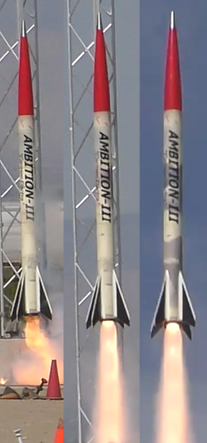

Ambition-III
Ambition-III was the culmination of 3 years of hard work by AeroBing's founders. As the last launch of the founders' AeroBing career, this launch had technical and sentimental significance for the team.
Ambition-III's point of failure was recognized to be a breach in the seals between the bulkhead and the first insulation liner, caused by a deformation in the bulkhead's walls - an issue previously not identified until the scaling of our manufacturing techniques yielded significant deformation.
The images shown depict the spread of the motor gasses from the breach point taken from a frame-by-frame analysis of our launch videos.
CAT-10 "Liza"
CAT-10 was a 1/3 scale of our spaceshot that explored new manufacturing techniques and insulative material choice. CAT-10 also served the purpose of allowing the new AeroBing admins a chance to design and build a rocket on their own. CAT-10 had an apogee of 4,000 ft as given from Featherweight data.
CAT-10's point of failure was the shear strength of the bond between the nozzle and the epoxy that held it in place. The rocket did not get to experience its full 6.5s burn and was otherwise recovered in great condition. CAT-10 will fly again on the team's next trip to FAR.
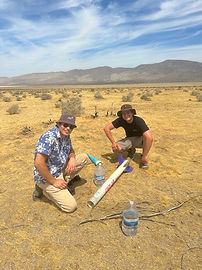

These images depict CAT-10 post recovery and pre-launch on the launch rail - the recovered CAT-10 in the left picture and the absence of a nozzle on the right. The clear ring is epoxy, the darker ring is our MSC and beneath that can be seen the unburned propellant.

Mar 2023
Our 5th trip to FAR served the purpose of launching our 3/4 scale rocket CAT-9.


CAT-9 "Kitty Hawk"
CAT-9 was our 3/4 scale launch and was the debut of new manufacturing techniques pertaining to fins, insulative liners, bulkhead and nosecone.
CAT-9's failure was attributed to the shear strength of the bond between the bulkhead and the airframe. The bulkhead unseated and left behind a ring of uninsulated fiberglass.
The images depict a before and after of the motor coming to pressure and a bright ring can be seen in the second picture; this is the area of uninsulated fiberglass airframe.
July 2022
On AeroBing's 4th trip to FAR, two rockets were launched - CAT-7 and CAT-5, whose launches had been previously scrubbed due to electronics failures.

CAT-7 "Lippman"
CAT-7 was a half-scale launch and our highest flyer so far! The purpose of this launch included the testing of our most sophisticated avionics system for its time and the validation of propellant composition and mixing procedures.

CAT-7's point of failure was a burn-through just above the nozzle. The burn-through produced instability in the rocket's trajectory and caused the fins to bow and fail. Rated for 49,000 ft (just under the limit of the standing FAR waiver), this rocket had its final apogee at around 12,000 ft.
The images show the progressive subtle bowing and subsequent rupture of the fins on the opposite side from the burn-through.
CAT-5 "Taylor"
CAT-5 was a refurbished rocket made from the remains of the mis-designated CAT-6. CAT-5's launch was far from our prettiest, but it's important to our team to stand by our failures as they make up the learning moments that continually shape us.
The images show the electronic bays flown in CAT-7 and CAT-5. These E-Bays utilized off-the-shelf GPS trackers and altimeters in addition to our homemade Arduino based data loggers.

May 2022
AeroBing's 3rd trip out to FAR featured the launching of CAT-8 - a roughly 1/3 scale rocket that aimed to reach 20,000 ft.